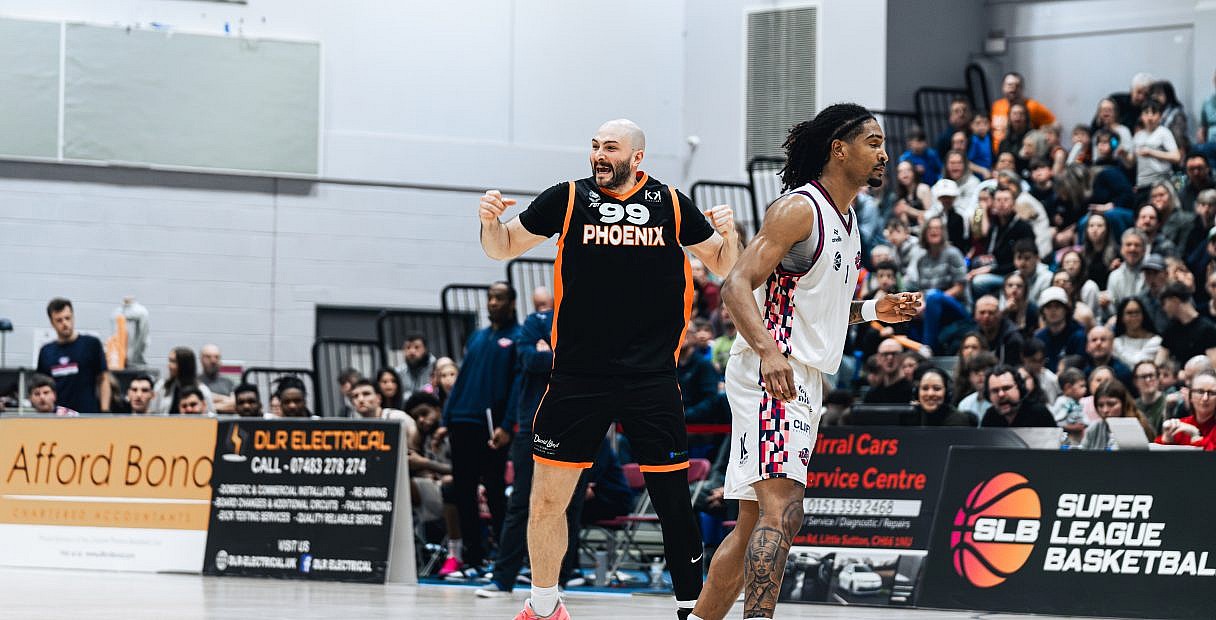
Skyler White didn’t celebrate right away.
When the ball left his hands, arcing high above the court in a now-familiar motion, there was a brief pause — the kind that only exists when history is hanging in the air. Then the net snapped, the crowd reacted, and a moment years in the making finally arrived.
“It was a very cool moment for me, the team, my family and everybody involved with the club I hope,” White says. “I was just relieved it went in to be honest, to get the pressure of it off my back and allow me to stop thinking about it and just play the game.”
With that shot, the Cheshire Phoenix captain became the club’s all-time leader in three-pointers made with 259 makes, surpassing a record long held by one of the most iconic figures in franchise history, FIBA Hall of Famer Pero Cameron, which had stood for 23 years.
It is the kind of milestone that cements a player’s place in a club’s story — but for White, the significance of the moment was as personal as it was professional.
“My son was there, my wife was there,” he adds. “I was so happy my family got to enjoy that moment with me, and I’m looking forward to the rest of the season now.”
Chasing — and catching — history
The record hadn’t always been on his radar. In fact, it barely registered at all when it was first mentioned.
“At the beginning of the season our analyst, Tom Fletcher, told me I had a chance to break it and I didn’t think anything of it,” White explains. “Until I got within maybe 20 makes and then it started to hit me.”
From there, it became unavoidable. Every made three brought him closer, every miss prolonged the wait. A couple of explosive shooting performances — six or seven makes in consecutive games — made it feel inevitable, but also heightened the anticipation.
“It felt like it would be over pretty quickly,” he says. “But now I’m glad to get it done and I can just concentrate on winning games again. That’s all that matters to me.”
That perspective — team success over individual accolades — runs through everything White says. The record matters, but only to a point.
“I love the record and it’s an honour to break it, but I just want to win,” he says. “If I do that for this team then I’m good.”
There is also an awareness of what — and who — came before him. Cameron, the previous record holder remains synonymous with Cheshire basketball, and for White, surpassing that mark carries a sense of responsibility as much as pride.
“He’s a legend, he’s Mr Cheshire Phoenix,” White says. “It was cool to have him reach out and congratulate me. I joked with him before that I was coming for his record, but there’s so much respect there. I’m honoured to be in the same conversation as somebody like him.”
Built on repetition
If the record is the result, the process stretches back decades.
White has been playing basketball for 25 years, but his journey into the game wasn’t linear. Growing up, he played everything.
“I was just an athlete,” he says. “I love sports, love competition, I played every sport you can think of.”
Basketball, though, became an obsession.
“I fell in love with being in the gym, on the court and getting shots up by any means necessary,” he says. “I spent hours on the court with my parents, on top of what I was doing at clubs.”
That early foundation — repetition, discipline, and a genuine love for the craft — would shape the player he would become. It also helped him adapt as he climbed through different environments across the United States.
From his hometown of Seattle to the intensity of New York, and later to school in Massachusetts and college in San Diego, each stop added another layer to his game.
“New York is a basketball Mecca,” he says. “That developed me a lot.”
But the path to becoming a professional was far from glamorous.
“I played in Portugal, Norway and the UK,” he says. “In those early days especially I wasn’t getting paid a lot of money or even no money, honestly, because I just loved to play.”
That willingness to keep going — regardless of circumstances — speaks to a deeper motivation.
“My family has always been really supportive of me doing what I love, and that gave me a lot of confidence to chase my dreams,” he says.
A career anchored by support
That support system has been constant, from his parents’ encouragement during childhood to the role his wife now plays in his career.
After a stint in Portugal, White moved to Surrey — a decision that would prove life-changing.
“That’s where I met my wife,” he says. “She’s been my rock through my entire career. I wouldn’t have been able to have this career without her.”
Even now, family remains central to everything he does — including his approach to the game itself.
His mother, who has a background in kinesiology, still offers technical advice on his shooting form.
“She’ll text me after a bad shooting night to remind me to point my toes,” White says, smiling. “It’s a running joke with the guys that when she comes to visit and gives me advice, I’ll score seven or eight threes in a row.”
It’s a light-hearted detail, but one that reflects a deeper truth: the habits that built his game have never really left him.
“I always just loved to shoot it,” he says. “Growing up I was really skinny and playing with older kids, I’d get pushed around inside. So I knew I had to prove I could shoot from outside.”
That necessity became a strength — and eventually, a defining feature of his career.
Now, as he moves into the later stages of his playing days at 32 years old, it’s also what sustains him.
“As I’m getting older and slowing down, losing some athleticism, the shooting aspect of my game is definitely prolonging my career,” he says. “That skill isn’t going to go away in the same manner.”
The road back
Like many athletes, White’s journey hasn’t been without setbacks.
The COVID-19 pandemic disrupted not just the sport, but the routines and structures that players rely on.
“It rocked me,” he admits. “Not being able to play, go work out, get in the gym — I struggled mentally.”
The way back required humility as much as determination.
“I signed in Norway for a coach I’d played for before in Portugal and told him I just needed to play,” he says. “I didn’t care about money, I’d take whatever I could get.”
That decision reignited his career — and ultimately led him to Cheshire.
“I found a way to be successful and that got the attention of Ben Thomas and Cheshire,” he says. “I’ve been rolling ever since.”
Under Thomas, White has flourished — not just as a shooter, but as a leader.
“He gives me the ultimate green light to do what I want to do out there,” White says. “He trusts my decision-making, my leadership. I’m very grateful to play for a coach like him.”
A unique dynamic
White’s story in Cheshire is unusual for another reason too: his family’s subsequent investment in the club after the British-American dual national signed there.
It’s a dynamic that could easily blur lines — but one he is careful to manage.
“I try to stay away from the business side of the club as much as I can,” he says. “My job is to play. I don’t get any special treatment — if anything I probably get a harder time of it from Ben because of the whole dynamic.”
Clear boundaries have been key, particularly with his mother.
“We do a great job of setting those boundaries — when we’re talking as mother and son versus owner and player,” he says.
Still, the connection adds another layer of meaning to moments like his recent record.
“This club is a family club,” he says. “Now we’ve very much made that the case too with the investment. It makes milestones like this even more special.”
It also brings added scrutiny — something White embraces rather than avoids.
“I definitely hear opposing fans saying I only get on the team because of my family,” he says. “But that just drives me on. I go out every day to prove that’s not true.”
What comes next
For all the individual success, White’s focus remains firmly on the bigger picture.
“I just want to win,” he says. “I want to be known as a winner. I want to get more silverware.”
There is a personal dimension to that ambition too. At home, reminders of past success sit within easy reach — and within the hands of his son.
“I have my medal from the Trophy Final a few years ago in the house and my son still walks around wearing it,” White says. “Now he’s getting older, I want him to see more of that.”
It’s a simple motivation, but a powerful one.
“I want to win for this team, for Ben, for my family,” he adds. “I have a lot of reasons to want success with this club, and I’m going to keep working as hard as I can to make it happen.”
The record may be his now, but for Skyler White, it’s already part of something bigger — a journey still very much in motion.